
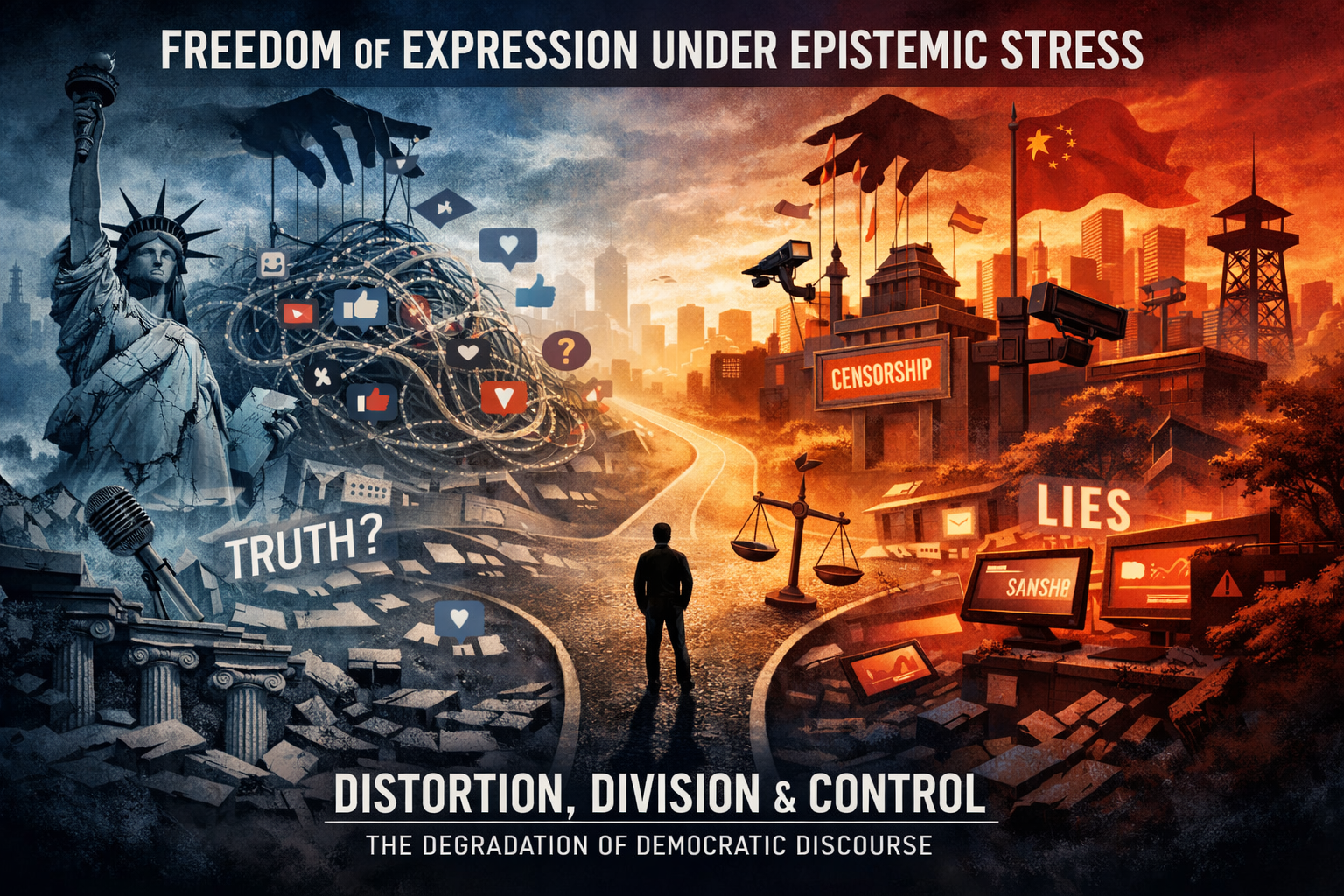
Freedom of Expression Under Epistemic StressStructural Degradation of Democratic Discourse and the Limits of Identity-Based Speech Control
Freedom of expression remains a foundational stabilizer of modern democratic systems. Yet under conditions of unbounded misleading exploitation, that stabilizer degrades—not through excess speech, but through the absence of mechanisms capable of differentiating structured argument from manipulative assertion.
This white paper demonstrates that the current failure is epistemic, not ideological. China resolves the resulting tension through identity-gated speech control, projecting surface stability by suppressing openness. Democratic systems preserve openness, but absorb stress internally, allowing misleading actors to exploit asymmetries of speed, cognition, legitimacy, and infrastructure.
The system appears stable because expression remains formally free. In reality, truth discrimination capacity collapses: moderation becomes reactive, trust erodes incrementally, and legitimacy loss accumulates without a clear point of failure.
Through structural diagnostics (ODP–DFP), empirical analysis of China-linked misleading operations, and examination of enabling logistics—including identity orchestration, influencer and lobbying capture, coercive leverage, and telecommunications infrastructure exposure—this paper shows that misleading exploitation thrives within open systems, not despite them.
The core risk is not pluralism.
It is indistinguishability.
No tactical remedies are proposed. The paper isolates the structural physics of the failure—and why systems that cannot assign epistemic weight based on argument structure inevitably cede informational dominance to those who exploit ambiguity.

Deferred Energy Transition under Security-Bound Continuity Stress
Why an Obsolete Coal Plant Remains Structurally Active
The forced continuation of Craig Station is not a story about coal, climate denial, or economic inefficiency. It is a story about structural dependency.
Despite formal commitments to energy transition, the regional grid remains anchored to legacy baseload assets that provide something renewables alone still cannot: firm continuity under stress. The 446 MW coal unit functions not as an energy preference, but as a systemic buffer, absorbing grid instability, transmission constraints, and security-sensitive load requirements.
This case reveals a deeper truth: the system appears stable not because the transition is complete, but because unresolved vulnerabilities are being temporarily masked by infrastructure that policymakers publicly claim to be ready to abandon.
The coal plant is not being chosen.
Time is.

Narrative Truth vs Structural Truth
In late-stage economic systems, the most dangerous narratives are not false — they are selectively true. They highlight scale, continuity, and survival while systematically omitting the question that actually matters: where the cost is being placed to preserve that stability.
China in 2025 is not best understood through collapse scenarios or resilience slogans. It is best understood as a system that remains standing by reallocating stress into compartments that decay slowly and quietly: households, corporate margins, subnational balance sheets, and peripheral external markets. The appearance of strength is real at the surface. The erosion beneath it is equally real.
As structural buffers approach saturation, narrative effort increases. Explanations give way to admonitions. Diagnosis is replaced by reassurance. Opinion voices become louder precisely when elasticity is lower. This is not coordination or propaganda; it is structural selection.
The analytical failure of mainstream commentary is not exaggeration, but omission. When narratives describe outcomes without identifying who pays the price, they stop being informative and become stabilizing devices.
This is the environment for which the Orthogonal Differentiation Protocol was designed: to separate narrative truth from structural truth, and to read systems not by what they say, but by what they can no longer afford to reveal.

Coupang and the Limits of Narrative Closure
Coupang’s 2025 data breach did not merely expose personal information—it exposed a structural fault line. The critical failure was not the intrusion itself, but the attempt to close uncertainty through self-certified forensic conclusions and to report those conclusions as settled fact across jurisdictions without independent sovereign validation. This maneuver compressed narrative time while structural risk continued to accumulate.
Under BBIU’s ODP–DFP framework, Coupang now emerges as a density-optimized system with high operational mass but narrow tolerance for trust erosion. Retention sensitivity, not capital scarcity, is the dominant risk vector. As time passes without credible closure, optionality erodes and uncertainty transforms from a buffer into exposure.

The Collapse of the EV-Only Doctrine and the Emergence of HEV as the Automotive Baseline
The apparent slowdown of electric vehicles is not a cyclical demand correction, nor a temporary policy hesitation. It is the exposure of a structural error: the attempt to force a mono-technology transition onto a system built on mass, inertia, and regulatory heterogeneity. As EV-only assumptions unravel under cost pressure, infrastructure limits, and geopolitical friction, Hybrid Electric Vehicles emerge not as a fallback, but as the load-bearing architecture of the global automotive system. This shift redraws competitive hierarchies, reassigns battery-sector risk, and reveals which industrial ecosystems can adapt—and which are structurally overexposed.

Coupang, Insider Sales, and the Manufactured Scapegoat
Korea’s domestic media response to the 2025 Coupang breach has not converged on the breach.
It has converged on a person.
The dominant framing reduces a population-scale security failure into a moralized storyline about the founder’s historical share sales—transactions that occurred in 2024, were disclosed through U.S. SEC filings, and predate both the estimated June 2025 intrusion onset and the November 2025 discovery window. This is not merely a factual misalignment. It is narrative substitution: the replacement of architectural diagnosis with symbolic accountability.
Under BBIU’s ODP–DFP lens, the real vulnerability is not insider-liquidity optics. It is retention fragility inside a density-optimized system with thin net-profit buffering. Coupang’s domestic logistics mass creates resilience against sudden collapse, but it also creates a high fixed-cost geometry that turns behavioral erosion into financial impairment faster than markets expect. The system looks stable because surplus absorption continues. It degrades because that surplus is sensitive to trust, not to capital scarcity.
The breach therefore functions as a structural exposure event. If active-user attrition persists beyond low single-digit thresholds—on the order of ~500,000 Korean active users—Coupang’s consolidated results can flip into sustained net losses under current cost rigidity, forcing defensive spending to contract. That contraction matters because promotions and lobbying are not optional tactics. They are stabilizers that buy time across political, regulatory, and competitive fronts. When cashflow tightens, time can no longer be purchased—and pressures that were previously suppressed converge simultaneously.
For institutional observers, the signal is not scandal.
It is sensitivity.

BBIU Edu | Corporate Reality Primer
Most young professionals believe the corporate ladder is a staircase: stable, linear, predictable.
But the real structure is a pyramid—narrow at the top, overcrowded at the bottom, and brutally steep in the middle.
At the summit stands a single CEO.
Below, thousands climb the slope, each hoping to rise one more level.
And while the company teaches them to believe in merit, discipline, and loyalty, the truth is far less romantic: the pyramid throws more people off its walls than it ever allows upward.
Capability matters, but politics decides.
Effort helps, but timing dominates.
Most fall not because they are weak, but because the pyramid was never designed for many to reach the top.
The message for the next generation is simple and uncomfortable:
your goal is not to climb blindly, but to understand the mechanics of the structure before you move.
In the end, careers are not won by those who ascend the fastest—
but by those who know when to climb, when to hold, when to leave, and when to build capacity that no pyramid can ignore.
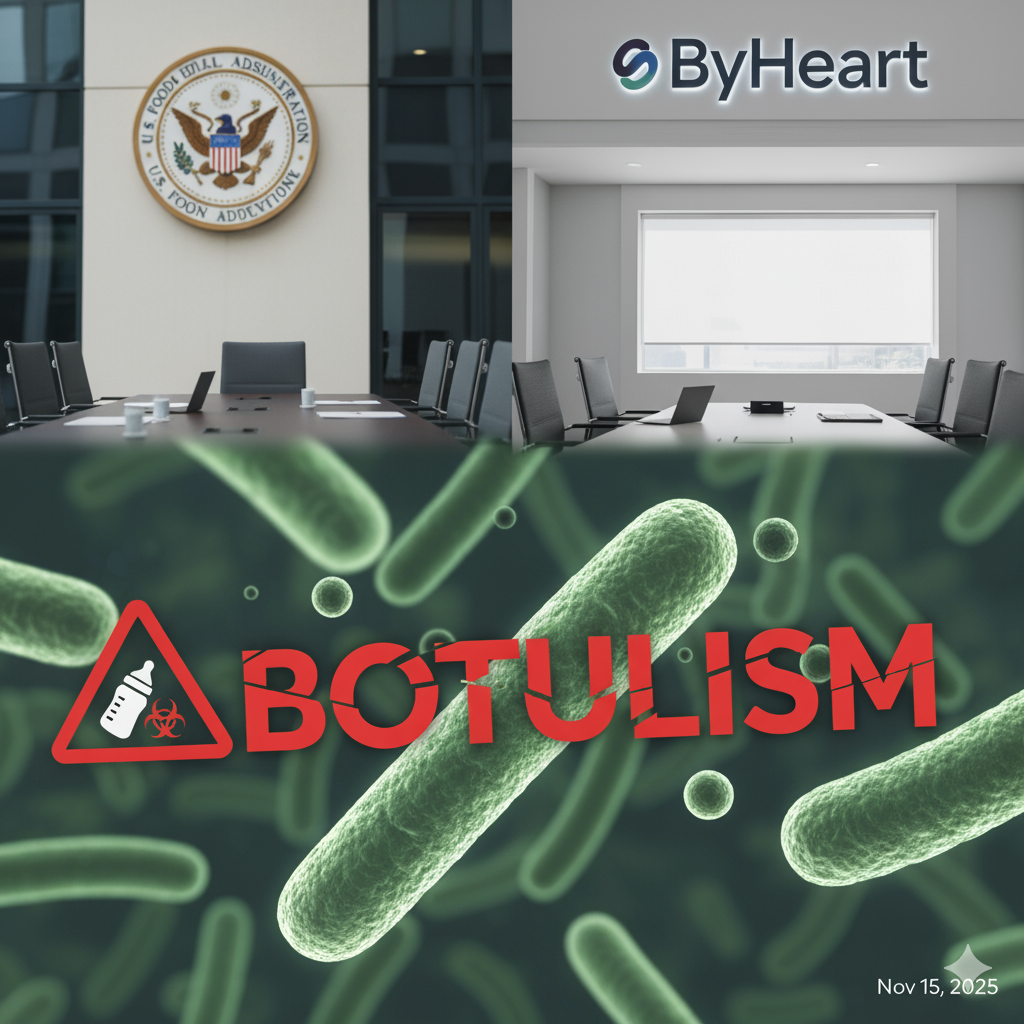
ByHeart Recall: When Structural Risk Meets Ethical Transparency
ByHeart’s nationwide recall of all infant formula — despite no confirmed contamination — marks a turning point in modern consumer ethics. What began as a technical response to two epidemiologically linked cases of infant botulism became a declaration of principle: that safety cannot wait for certainty. The decision exposed the hidden fragility of “clean” manufacturing systems, where Clostridium botulinum spores can survive pasteurization and infiltrate through air, dust, or packaging rather than ingredients themselves.
In a world accustomed to reacting after evidence appears, ByHeart acted before proof — redefining responsibility as epistemic integrity rather than compliance. The episode reveals that the greatest threat to safety is not contamination, but hesitation. When uncertainty involves infants, truth must move faster than data.

The Clean Oil and the Contaminated Flesh: Radiological Integrity Across the Pacific Food Chain
The New England Journal of Medicine’s November 7 trial proved that purified fish oil — molecularly distilled, stripped of hydrophilic residues, and verified for ionic purity — can reduce cardiovascular events by 43% in dialysis patients. Just twelve weeks earlier, BBIU exposed the opposite outcome: Walmart’s shrimp recall after FDA detection of cesium-137 contamination.
Between these two events lies the full spectrum of the ocean’s truth: one half transformed into medicine through refinement, the other left vulnerable through opacity. Cesium binds to muscle, not fat; purification separates energy from residue. The same sea nourishes both healing and hazard — and only human discipline decides which form reaches the plate.
Purified truth heals; unfiltered nature remembers.

BBIU Edu | From Instruction to Education: Building a Junior Career Beyond Certificates
In today’s corporations, instruction is abundant but education is scarce. Certificates, MBAs, and PhDs prove compliance with institutional requirements, but they do not prove judgment. A junior who waits for guidance remains replaceable; a junior who maps workflows, identifies key actors, and embeds personal logic into every deliverable becomes irrepeatable. The difference is existential: instruction produces tasks, but education produces authorship.
Annexes
Annex 1 — Personal Experience: Reconstructing Education as a Product Development Manager
Annex 2 — Personal Experience: Facing Dark Intentions in the Field
Annex 3 — Rulebook for Juniors: Survival and Progress in the Corporate World
Annex 4 — The First Weeks and the Irreversibility of TimeIn today’s corporations, instruction is abundant but education is scarce. Certificates, MBAs, and PhDs prove compliance with institutional requirements, but they do not prove judgment. A junior who waits for guidance remains replaceable; a junior who maps workflows, identifies key actors, and embeds personal logic into every deliverable becomes irrepeatable. The difference is existential: instruction produces tasks, but education produces authorship.
Annexes
Annex 1 — Personal Experience: Reconstructing Education as a Product Development Manager
Annex 2 — Personal Experience: Facing Dark Intentions in the Field
Annex 3 — Rulebook for Juniors: Survival and Progress in the Corporate World
Annex 4 — The First Weeks and the Irreversibility of Time
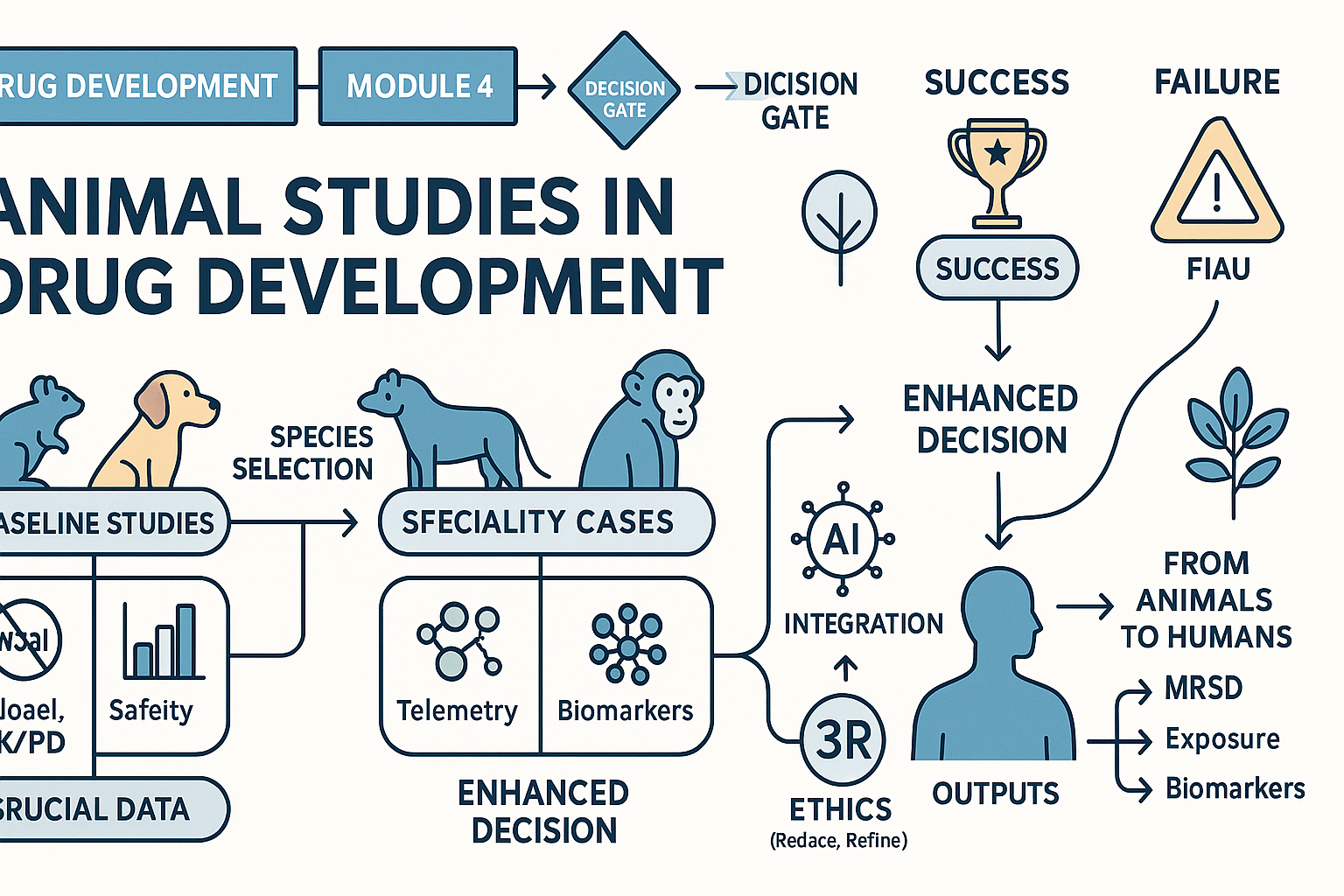
BBIU Edu | From Molecule to Man: The Structural Role of Module 4 in Drug Development
Drug discovery no longer lives on serendipity alone. After a candidate clears in-vitro hurdles in Module 3, it faces a narrow bridge toward Module 4—preclinical studies in animals—where theory meets the complexity of life.

BBIU-Edu | From Wellness Vision to Business Intelligence: Lessons from a 2007 Health Resort Project
Between 2006 and 2008 I developed and defended a project that was ahead of its time: a Health Resort uniting Oriental and Western medicine under one roof. With a CAPEX of USD 2 million and packages priced at USD 5,000–7,000, the vision was to compete with global leaders like Evian and Lanserhof rather than local spas. The project was never built, but the process of shaping it through Desafío Joven and NAVES IAE transformed the way I see leadership, timing, and structural thinking. Nearly twenty years later, the lessons remain: solitude is part of leadership, timing is about ecosystems as much as markets, and even unfinished projects can lay the foundations for future frameworks.

BBIU Edu | From Lab Bench to FDA Approval: Why Module 3 Defines the Fate of Every New Medicine
Behind every clinical trial headline lies a less visible but decisive document: Module 3 of the Common Technical Document (CTD). Known as the Quality dossier, it is the regulator’s lens into whether a new medicine can be manufactured consistently, safely, and at scale. While Module 5 demonstrates what a drug does in humans, Module 3 demonstrates whether it can be made the same way, every time.
For the FDA, EMA, and other global regulators, Module 3 is not bureaucratic formality but the anchor of trust. Weaknesses here have caused billion-dollar delays, forced global recalls, and even put patients at risk. From laboratory synthesis to industrial manufacturing, from stability tests that define shelf life to inspections that verify SOPs and batch records, Module 3 is the living blueprint of pharmaceutical reliability.
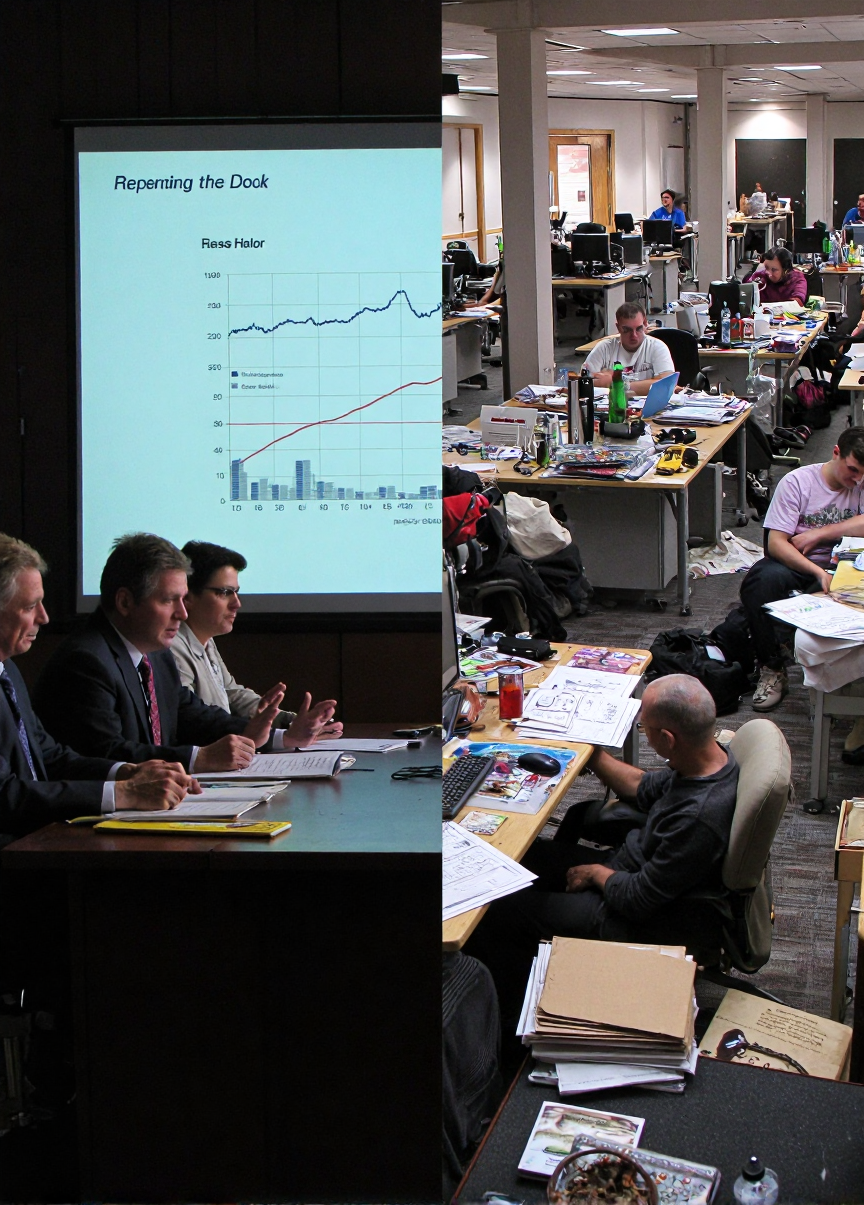
BBIU Edu | The Hidden Cost of Filtered Information: How Corporations Lose Reality Between Middle Management, Consultants, and the Board
“In global corporations, truth rarely travels intact from the field to the boardroom. By the time information reaches the C-level, it has been filtered, reframed, and repackaged—first by middle managers protecting their careers, then by consultants producing ‘independent’ reports tailored to justify decisions already made. What results is not a strategy grounded in reality, but a carefully curated fiction. The cost of managing symbols instead of facts is cumulative: wasted capital, operational blindness, reputational damage, and ultimately, strategic drift. Only by building direct circuits—listening to juniors, walking the field unannounced, and commissioning independent micro-surveys—can executives reclaim their epistemic sovereignty and see the organization as it truly is.”

BBIU-Edu | CTD Module 1: Generality & The U.S. Regulatory Gateway
No matter how strong the clinical data in Modules 2–5 may be, a single omission in Module 1 can collapse an entire drug application. The FDA does not open the scientific dossier until the administrative, legal, and labeling requirements are validated. This means that a missing signature on Form 356h, an inaccurate patent certification, or an incomplete investigator disclosure can outweigh hundreds of millions invested in trials.
History confirms this. AstraZeneca’s Brilinta was delayed nearly a year in the U.S. due to filing deficiencies, even as Europe moved forward. Epix Pharmaceuticals lost over 40% of its market capitalization in a single day when the FDA refused to file its Vasovist application. In each case, the problem was not science—it was governance.
For professionals entering regulatory affairs, the lesson is stark: Module 1 is not paperwork, it is sovereignty and market trust encoded in legal form. To master it is not only to secure approval, but to shield a company from financial collapse and reputational damage.

BBIU Edu | From Phase 3 to Pharmacovigilance: Understanding the Continuum of Drug Development Beyond Approval
Most public discussions around drug development end at Phase 3 clinical trials—the so-called “pivotal studies” that determine whether a medicine receives regulatory approval. Yet, in reality, the journey does not end there. Once Phase 3 concludes, a drug enters a complex transitional space involving regulatory review, strategic bridging studies, and ultimately the system of post-marketing surveillance (PMS) and pharmacovigilance.
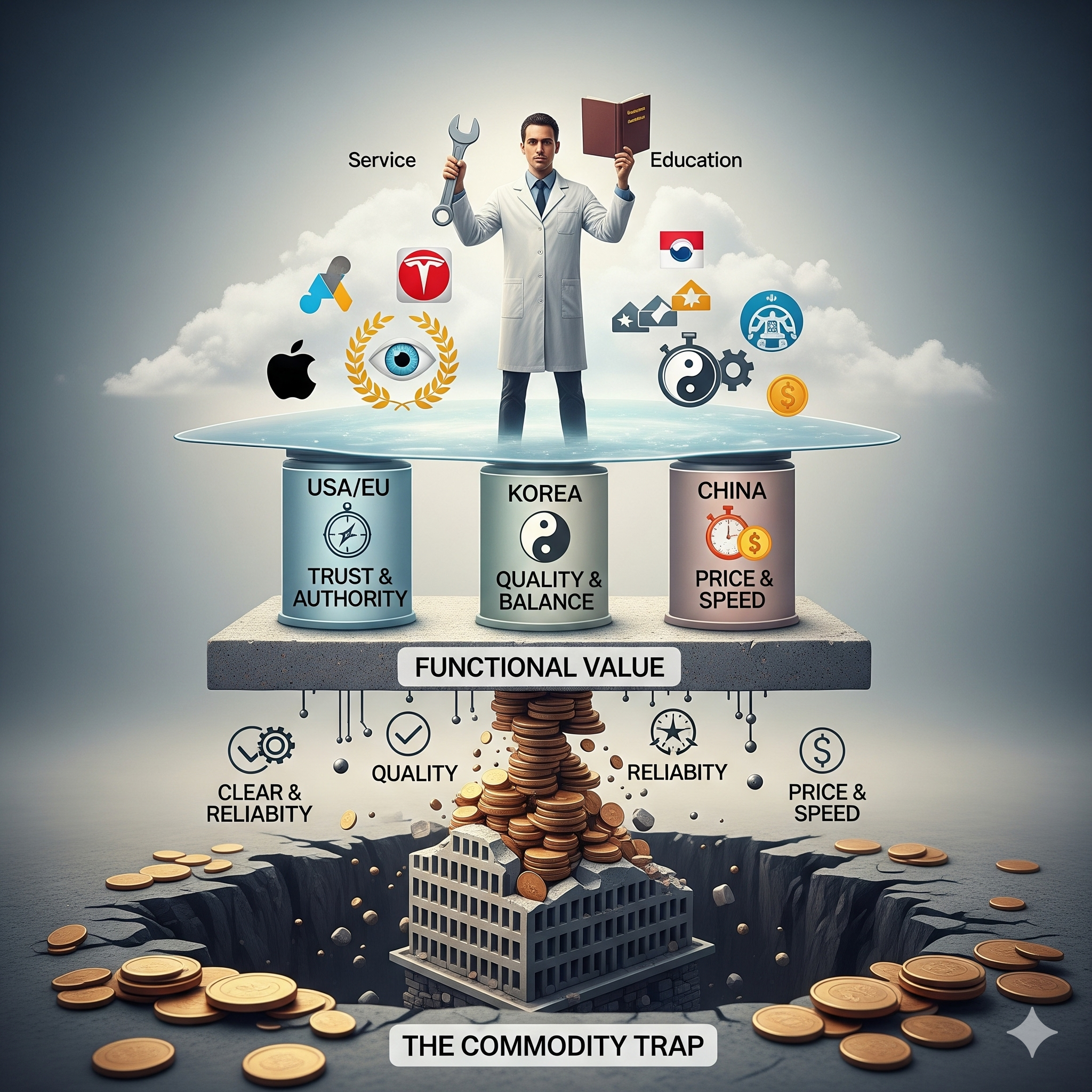
BBIU Edu | Perceived Value, Price, and the Global Marketing Divide: China, Korea, and USA/EU
Perceived value is never determined by price alone. Across industries—from biopharma to aerospace and consumer technology—companies that rely exclusively on discounts or cost advantages fall into the “commodity trap,” eroding margins and trust. Real-world failures such as Rezulin in pharma, Boeing’s 737 MAX in aerospace, and Kodak in photography show how quickly reputations collapse when safety, innovation, or after-sales support are neglected. In contrast, long-term successes like Dupilumab, Apple’s iPhone ecosystem, and Tesla’s Model S demonstrate that customers willingly accept higher prices when companies invest in education, communication, service reliability, and symbolic leadership. The lesson is universal: sustainable value emerges when firms build trust and authority across every layer of the customer experience, not when they treat price as the only switch.
BBIU Edu | How Biopharma Makes Money: From Early-Stage Molecules to Biosimilars
Biopharma’s business model is not a straight path from laboratory to pharmacy. Value is created in stages: small biotechs de-risk molecules through Phase 1 and 2, Big Pharma acquires late-stage assets, and regulatory approval transforms data into revenue. Patents protect profits, but once they expire, biosimilars enter and revenues collapse. Understanding this cycle is key to seeing how science, finance, and regulation converge in the drug industry.
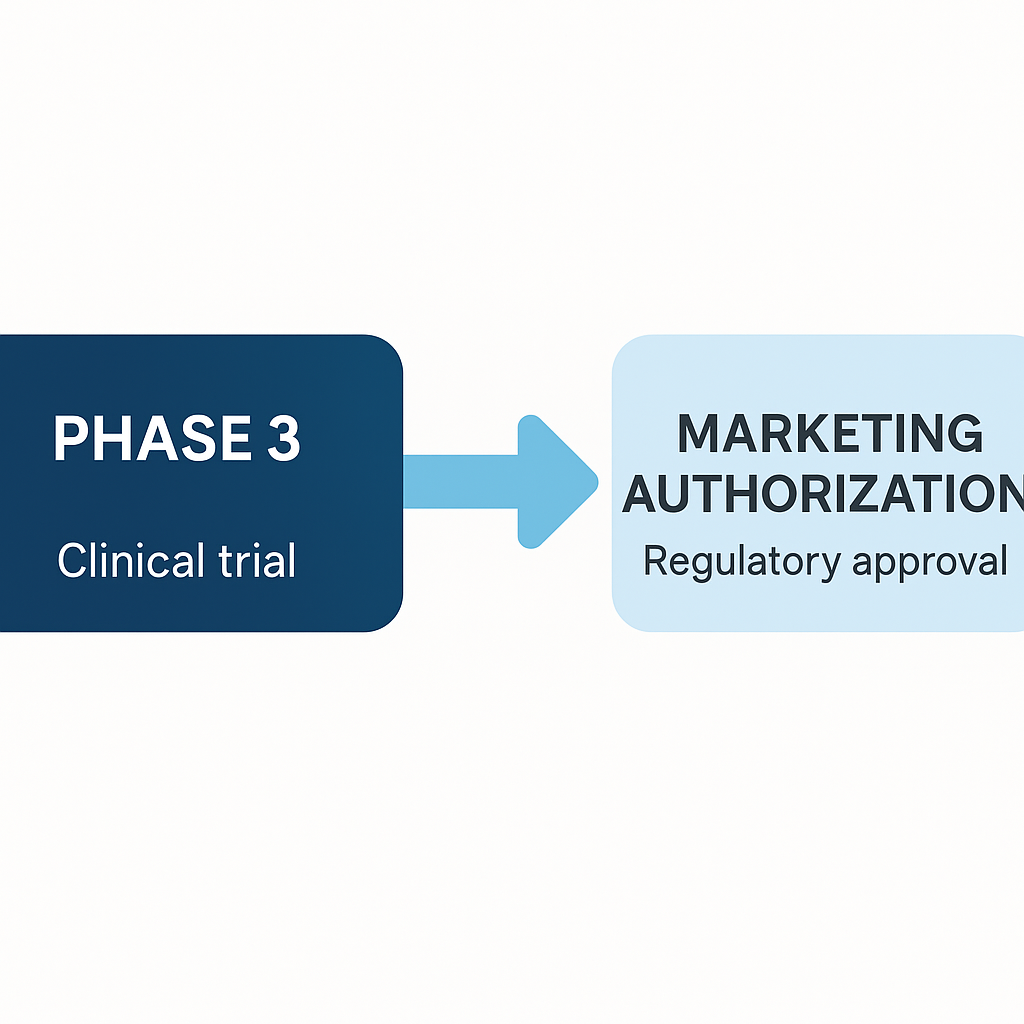
BBIU Edu | Phase 3 Clinical Trials and the Road to FDA Approval
Phase 3 clinical trials mark the decisive threshold in drug development. They move beyond exploratory signals to confirm whether a therapy can truly change outcomes at scale. From dose selection and comparator choice to FDA’s NDA review, this stage fuses science, regulation, and economics. Success can transform a biotech into a global player, while failure can erase entire companies. Behind every approved pill lies not just laboratory research, but the crucible of Phase 3.

BBIU Edu | From Preclinical Data to Early Clinical Trials: Structure, Ethics, and Integrity
Every clinical trial rests on a fragile bridge between laboratory predictions and human reality. Preclinical data provide reassurance that a drug may work and can be given safely, but it is only when the first human subjects are exposed that true risks emerge. This is why early phases focus less on proving efficacy and more on monitoring safety — with every adverse event documented, and every serious event (SAE) escalating through investigators, sponsors, and regulators. The system exists to prevent isolated signals from becoming systemic tragedies.